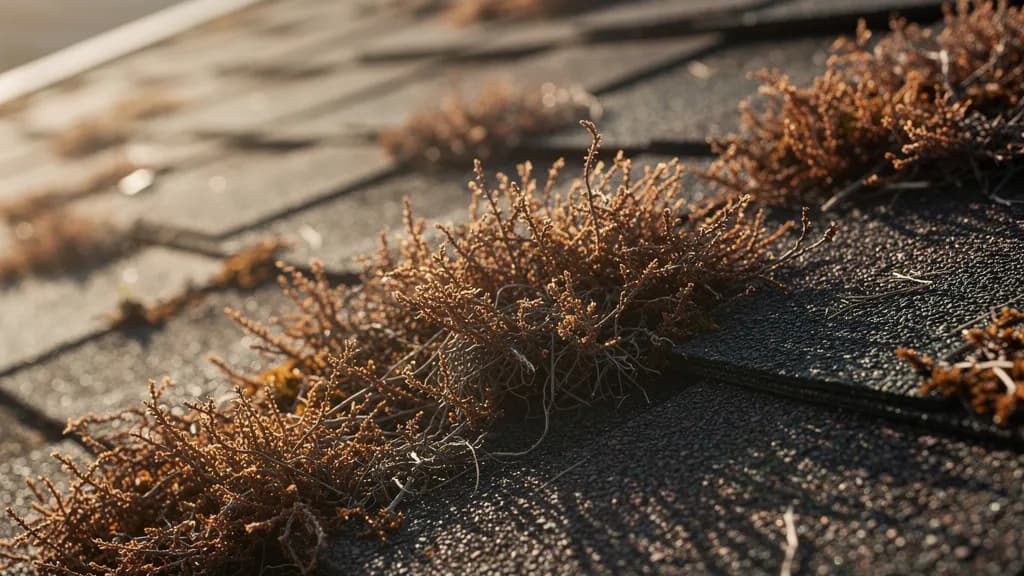

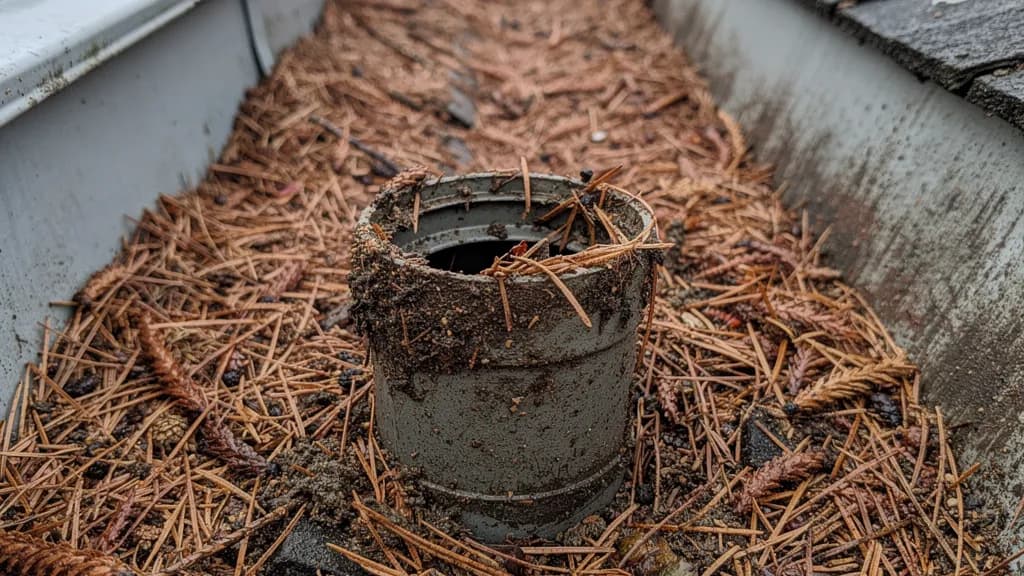
Picture a clogged gutter and you probably picture leaves: a trough heaped with big brown maple leaves, obviously full, obviously overdue. That image comes from somewhere else. Under the fir and cedar that cover most of the South Sound, gutters fail a different way, and the reason so many homeowners are caught out is that a gutter packed with conifer needles can look empty from the ground.
Leaves sit on top, needles sink
A maple or alder leaf is wide and flat. It lands on the surface of whatever is already in the gutter and it stays there. Leaves bridge across the trough, pile at the downspout opening and build a visible mound. They are also seasonal. There is a window of a few weeks in the fall and then it is over.
A fir needle is small, narrow, stiff and waxy. It does not bridge. It slides down past whatever is in the way and settles on the floor of the trough, and the next one packs in beside it. Over a season the needles knit into a dense felt along the bottom, soaked and heavy, while the top of the gutter still looks clear. Cedar sheds differently again: it drops whole flat sprays of scale like foliage that lock together like little shingles and mat even faster.
Neither of them waits for fall. Douglas fir drops older needles through the year with a heavier shed in late summer and fall, and cedar does its own around the same stretch. So the standard advice everywhere else, one cleaning timed to the end of leaf fall, leaves a gutter under conifers loaded again well before spring.
Why packed needles do more damage than leaves
They reach the downspout as a plug, not a pile. Leaves jam at the opening where you can see them and pull them out. Needles go down the spout and wedge at the first elbow, inside the pipe and out of sight. That is why a downspout can be fully blocked while the gutter above it looks fine.
They hold water in the trough. Wet needle felt does not drain. A gutter carrying a soaked mat along its floor is holding weight it was never hung for, all through the wet season, which is how hangers pull loose and a run starts to sag and hold even more.
They break down into soil. Needle litter rots into a fine dark sludge, and that sludge is a growing medium. Moss, grass, fir seedlings and maple seedlings all start life in gutters here. Once something is rooted in a trough, the gutter holds water by design.
They keep metal and wood damp. A mat pressed into a gutter seam keeps that seam wet year round. The same mat riding over the back edge keeps the fascia wet behind it, where nobody looks.
How to tell a gutter is full when it looks empty
From the ground, on a dry day:
- A vertical dirt stripe on the siding below one section of gutter, or staining under a seam.
- Water spilling over the front edge in ordinary rain, not just in a downpour.
- Water coming out of the top of a downspout joint instead of the bottom.
- A run that dips in the middle or pulls away from the fascia.
- Anything green growing along the top edge of the gutter.
- A line of drip marks on the driveway or a trench worn into the bark below the eave.
- A downspout that sounds solid rather than hollow when you knock on it low down.
Then do the version that actually tells you the most: go outside during a heavy rain and stand there for five minutes. A working system is quiet and boring. Listen for a waterfall at one corner, a drumming downspout next to a silent one, or water going past the gutter entirely and landing in the beds.
What about gutter guards
Guards are a reasonable answer to leaves and a poor answer to conifers, which is worth knowing before you spend money on them.
Mesh and screen guards catch leaves and either let needles through or get stood up and blinded by them. Reverse curve covers use surface tension to pull water around a lip, and fine debris rides around with the water. Foam inserts fill with needle litter and become the clog themselves. None of these products is a con. They just were not designed for what falls out of a fir.
What guards really change is access. Once a system is covered, clearing it means taking the guards off and putting them back, which is more work rather than less. If guards are already on your house, keep them, and plan on the system being checked rather than forgotten.
Interior and exterior are two different cleanings
We offer both an interior and an exterior gutter cleaning, and they are not the same job.
Interior is the trough and the downspouts. Everything comes out, the needle felt comes off the floor, the elbows get cleared and every spout is confirmed running. That is the functional half, the one that keeps water off your siding and away from the foundation.
Exterior is the face and the underside of the gutter. Aluminum oxidizes and holds a chalky film, and the dark vertical bars you see on white gutters are a mix of that oxidation and roof runoff. It does not come off with a rinse and it is purely cosmetic, but it changes how the whole roof line reads from the street.
Our gutter cleaning carries a 60 day warranty after the cleaning at no extra charge, which matters most in the fall when a windy week can undo a clearing within days.
How often, under conifers
There is no single right interval, and anyone who gives you one without looking at your trees is guessing. The useful way to think about it is the canopy, not the calendar.
An open lot with nothing overhanging is often fine with one clearing a year. A house under a stand of fir, with branches over the roof, generally wants two: one after the heavy late summer and fall shed and before the rain settles in, then a second pass at the end of winter to clear what the storms brought down. A roof that already carries moss adds to the load on its own, which is why a mossy roof and a packed gutter almost always arrive together.
If you would rather have a straight answer for your own house than a rule of thumb, book a visit and we will tell you what is actually in the trough. Our season by season rhythm lays out where gutter work falls against the rest of the year.