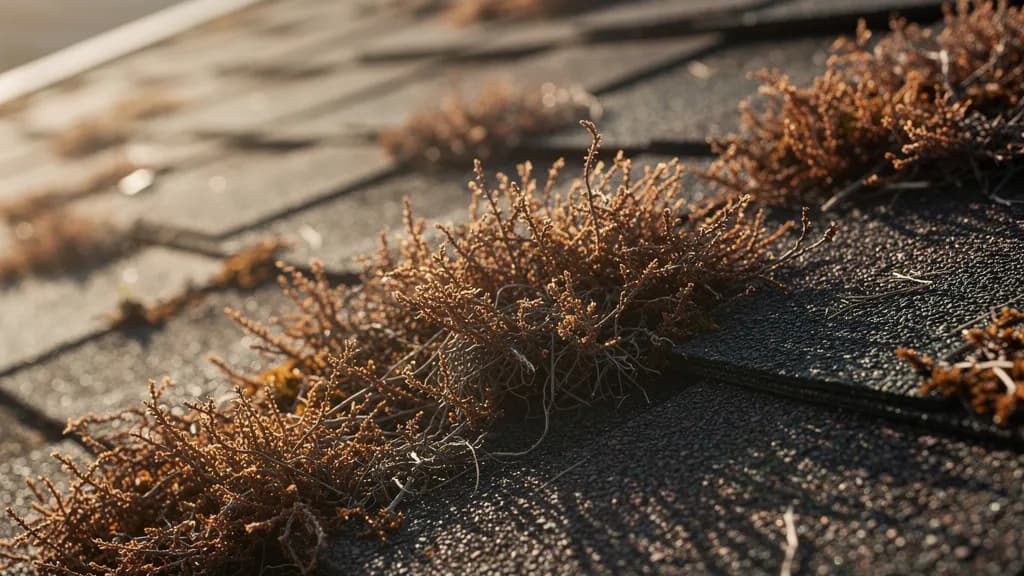
Walk out in the middle of a dry August and look up at the shaded slope of your roof. The moss that was bright green in the spring is brown, flat and crisp. It looks finished. Homeowners tell us all the time that the summer took care of it. It did not. That mat is alive. It is shut down, and the first steady rain of the fall will switch it back on.
Moss does not die, it dries out
Moss is not built like the plants in your beds. It has no roots pulling water up from soil and no waxy skin holding moisture in. It takes water straight through its surface, and when the water is gone it lets itself dry out completely and stops. That is dormancy, and moss is unusually good at it.
Rehydration is fast. Put water back on a dormant mat and it turns green and starts working again quickly, not over a season. That is why a roof can look bare in late summer and be visibly green after one wet weekend. Nothing grew back in seven days. It simply came out of standby.
This matters because it changes how you read your own roof. Brown moss is not a problem that solved itself. It is the same problem, paused, in the one window of the year when it is easiest to deal with.
Why the South Sound suits it so well
Two things make this area close to ideal for roof moss.
The first is the rain pattern. The wet stretch here runs from fall through late spring, and it is mostly steady and mild rather than heavy and brief. Moss wants exactly that: long periods of damp, not downpours. Even outside the wet season, mornings leave fog and dew on a shaded slope, which is enough to keep a mat ticking over.
The second is the trees. Douglas fir and western red cedar shade roofs all over Covington, Maple Valley and Renton, and they do two jobs at once. They keep the sun off the shingles, so a slope under a canopy may never fully dry between rains. They also drop needles and small branchlets that settle into the shingle courses and hold moisture like a sponge. Needle litter breaks down into a thin layer of organic debris, which is the closest thing to soil a roof will ever have. Spores land in it and take.
Winter is no help either. Cold kills moss only when it is hard and sustained, and our winters rarely get there. A frost or two is a pause, not an end.
Put those together and the growth window runs most of the year, with a short dormant break in the driest part of the summer, then straight back into it.
What moss actually does to a roof
Four things happen, in roughly this order.
It holds water against the shingle. An asphalt shingle is built to shed water and then dry. A wet mat sitting on it keeps the surface damp for days after the rain stops, which is hard on the asphalt and on everything under it.
It works under the shingle edge. Moss anchors with fine filaments that get into the granule layer and into any seam they can find. As the mat thickens it lifts the bottom edge of the tab above it. A lifted tab catches wind and lets wind driven rain get under the course.
It takes granules with it. Those granules are the shingle's sunscreen. Once they are gone the asphalt underneath is exposed to sunlight and begins to dry and crack. This is the part that decides whether moss costs you a cleaning or a roof.
It moves into the gutter. Every rain washes loose moss and broken down needle litter down the slope and into the trough, where it keeps growing in standing water. A roof with a moss problem almost always has a gutter problem underneath it.
Why brushing beats pressure
We remove moss from a roof by brushing, not by pressure washing. The gutters are included in that work, along with a pet and plant safe moss treatment.
There is a reason for the method. Pressure strips granules. A wand held at roof range takes off the mat and a layer of the shingle's protection with it, and nothing about that damage is visible on the day. It shows up later as a roof that wears out early. Pressure also drives water uphill, under the courses, in the one direction a shingle roof was never designed to handle.
A brush is slower and more selective. It lifts the mat off the surface and out of the seams and leaves the granules where they belong. Dormancy actually helps: a dry mat in late summer releases in sheets, while a soaked one smears and has to be worked.
Once the mat is off, a treatment goes down to kill what is left in the seams and slow the next round. That is a different job from treatment on its own. A treatment kills and discourages moss, but it removes nothing, so on a roof that already carries a thick mat it leaves you with dead moss still sitting there holding water. This is why our roof cleaning and moss removal pairs brushing with a treatment, and why a moss treatment by itself makes the most sense on a roof that is still clean.
Washing a roof is a separate question again. It has a place, for dirt and dark staining rather than for moss, and the difference between pressure washing and soft washing is worth understanding before anybody points a hose at your house.
What to look for from the ground
You do not need to get on the roof, and we would rather you did not. Most of what matters is visible from the driveway with a pair of binoculars.
- Green or dark clumps along the shingle courses, thickest on the shaded slope and anywhere a branch hangs over.
- Shingle tabs that sit proud of the course below them instead of lying flat.
- Dark streaks running down from a chimney, a vent or a valley.
- Needle litter piled in the valleys and along the lower edge.
- Granules collecting in the gutter or washing out of the downspout onto the driveway.
- Anything green growing in the gutter itself.
What you can do between cleanings
Keep branches off the roof. Any limb that touches or overhangs a slope is shading it and feeding it at the same time. Trimming back is the single most useful thing a homeowner can do here, and it is the one change that alters how fast the moss returns.
Keep needle litter out of the valleys and off the lower courses, because that litter is the seedbed. Keep the gutters clear for the same reason: needles that pack into a trough turn into a growing medium, and conifer debris behaves nothing like the leaves most advice assumes.
Do not pressure wash it yourself. Do not take a stiff metal brush to it. Skip the loose powders sold for sprinkling along a ridge: they streak, they wash off in the first storm, and they end up in the beds below.
And do not read a brown roof in August as a roof that fixed itself. The best time to get a mat off is while it is dry and dormant, before the fall rain brings it back. If nobody has looked at yours in a while, book a visit and we will tell you what is actually up there. Our season by season rhythm for South Sound homes shows where roof work falls against everything else on the house.