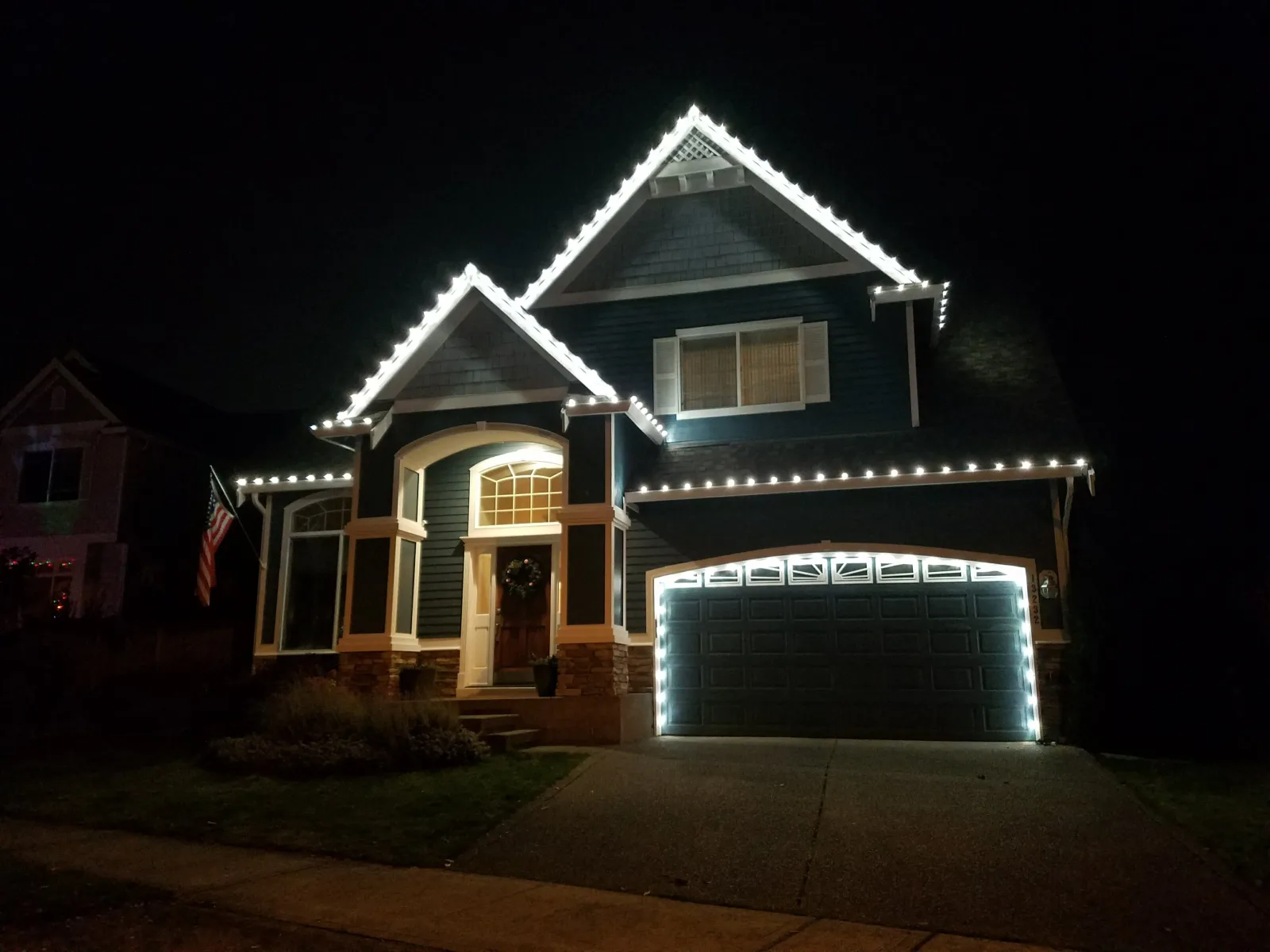
Almost every holiday light problem we hear about traces back to how the lights were attached. Not the bulbs, not the timer, not the cord. The hardware. And the decision that matters most is whether the run hangs off the gutter line or gets fixed to the roof itself.
What a staple through a shingle actually does
A staple or a roofing nail driven through a shingle makes a hole in the layer that keeps water out of your house. It is above the living space, it is tucked under the course of shingles above it, and it is going to stay there long after the lights come down, because nobody climbs up to pull staples out of a roof in the middle of winter.
Sealant does not solve it. A dab of caulk over a roof penetration is a temporary patch that shrinks, cracks and lets water in behind it, and now it also hides the hole from anyone who inspects the roof later.
Cold makes it worse. Asphalt shingles are flexible when they are warm and brittle when they are cold. Lifting a tab in the wet chill we get here is how a shingle cracks across the tab, and a cracked tab in the middle of the wet season is a leak waiting for a windy night.
Then there is what the strand does while it is up there. A line of wire lying across a shingle field traps needle litter and holds water against the roof through the wettest stretch of the year, which is the same mechanism that grows moss in the first place.
Adhesive clips and the other shortcuts
Adhesive hooks. Cold and wet is the exact condition adhesives fail in. They let go in the first real wind, usually taking half a run with them, and the ones that hold leave residue stuck to the surface.
Hot glue. Holds for a while, then comes off with a piece of whatever it was stuck to.
Tape and zip ties around the gutter. Tape fails wet. Zip ties work fine until you are up a ladder in the cold cutting every one of them off.
Nails into the fascia. Better than the roof, but still a hole, and it is in the board that holds the gutter up.
Why the gutter line is the right place
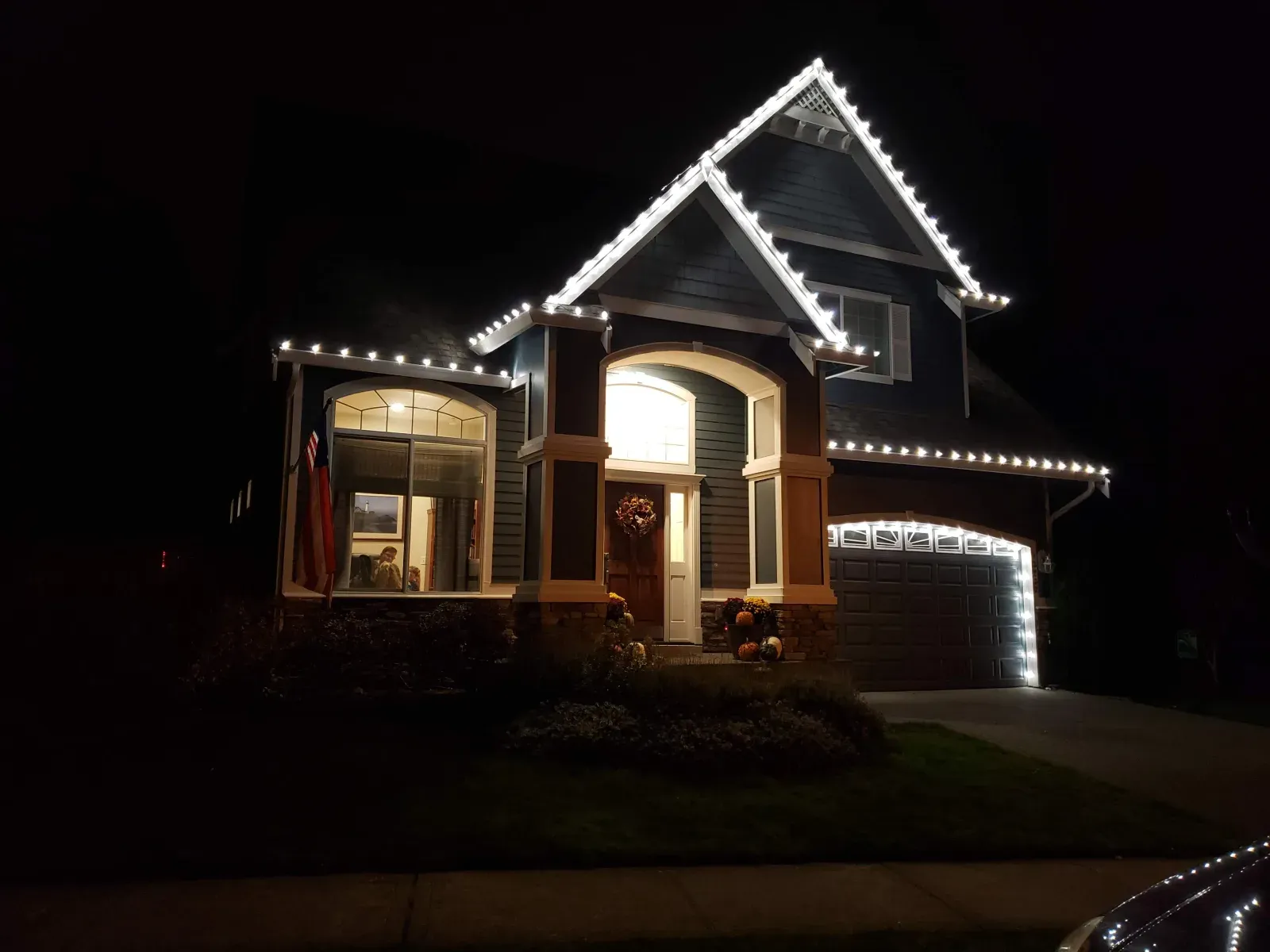
A gutter is a continuous, straight, structural edge at exactly the height lights should read from, and it was built to have something hooked over it. An all in one clip hooks over the gutter lip and holds the bulb at a set angle and spacing. Nothing is fastened, glued or penetrated.
The look is better too, and the reason is architectural. The fascia and gutter line is the strongest horizontal line on the front of a house. A run of lights following it reads as one clean edge from the street. A strand across a shingle field has nothing to follow, so it wanders, and the eye picks up the wobble immediately on a wide roof.
Where a run has no gutter, there is still a fastener free option. A shingle tab clip slides under the edge of a shingle and grips it without making a hole. It is a compromise rather than a first choice, which is why it is worth knowing in advance which sections of a roof will need one.
We keep it simple: the roofline and the gutters, and we do not do trees or bushes. That is a deliberate choice. Plant material grows and moves, anything wrapped around a branch ends up cutting into the bark or getting grown over, and pulling a strand out of a soaked rhododendron in midwinter is a bad time for everybody.
The gutter has to be right first
Here is the part almost nobody thinks about until install day. Clips hook over a gutter, which means the gutter carries the run.
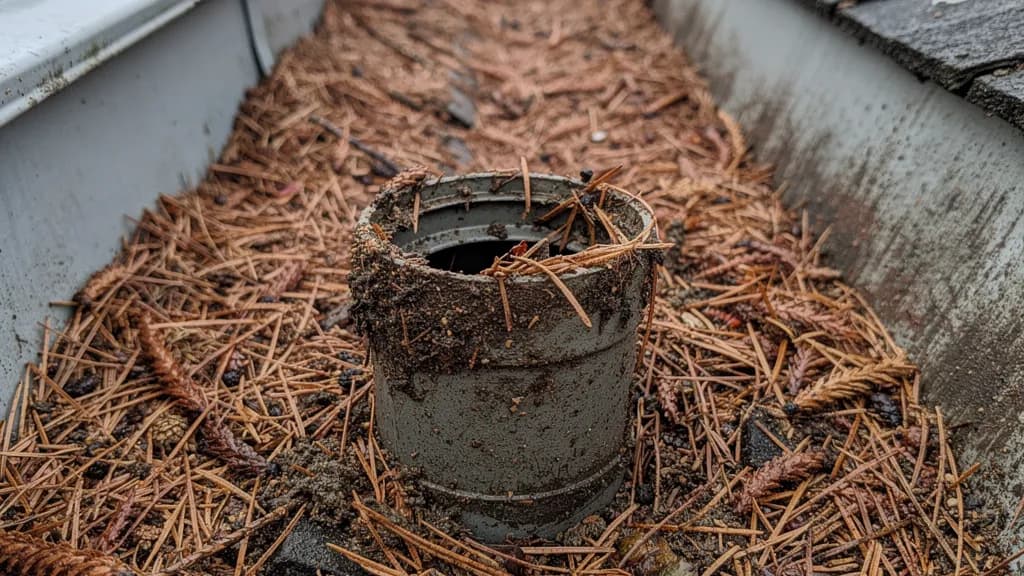
A gutter full of soaked conifer needle sludge is already holding weight it was never hung for, and the hangers on an older run may be part way out of the fascia without anyone knowing. That is why fall gutter clearing and a light install belong in the same stretch of the year, in that order. Needles pack the floor of a trough where you cannot see them, so an apparently empty gutter tells you nothing at all.
Worth checking before anything goes up:
- The trough is clear and every downspout runs.
- No section sags or pulls away from the fascia.
- The gutter lip is not bent or crimped where a ladder has been.
- Nothing is rooted in the trough.
- Any gutter guard system is accounted for, because covers change what a clip can hook over.
Cut to the house, not to the box
Retail light sets come in fixed lengths, so a house ends up with whatever combination of runs adds up closest, and the excess gets bunched at a corner or doubled back on itself. Lighting built for the house is measured and cut to the run, so every line ends where the roof ends and the spacing stays even the whole way across.
That is the approach behind our holiday lighting: custom built, in the colors you choose, using high quality professional grade lights, whether you want something clean and simple or a display with more personality in it. Even spacing on a straight line is most of what separates a finished display from a homemade one. It is also the difference between one bulb out being invisible and the whole run looking wrong.
Power, and the things that get forgotten
- One circuit, checked first. Exterior lighting usually runs off a single outdoor outlet, so it is worth knowing what else is on that circuit before you find out the hard way.
- Outdoor rated cords only, and as few joins as you can manage.
- Connections out of the water. A join sitting in a gutter trough or in a puddle on a flat porch roof will find water eventually. Keep them up and under cover where you can.
- A timer beats remembering. It also keeps the run off during the hours nobody is looking at it, which is easier on the lights.
- Test the outlet in the fall. A dead exterior outlet is a small problem in October and a large one on install day.
Taking them down matters as much as putting them up
The hardware choice comes due at removal. Clips lift off a gutter lip in order and the house goes back to exactly how it was. Staples stay in the roof for the next decade, and every one of them is a hole nobody remembers making.
Damp matters here too. Lights and clips that come down wet and go straight into a box come out of that box corroded, so anything stored should be dry and coiled rather than bundled.
If you want a straight roofline of lights and not one hole in your roof, talk to us in the fall rather than during the first cold snap. Book a visit while the weather still makes it an easy job. Our season by season rhythm shows where the install lands against the rest of the year's work on the house.